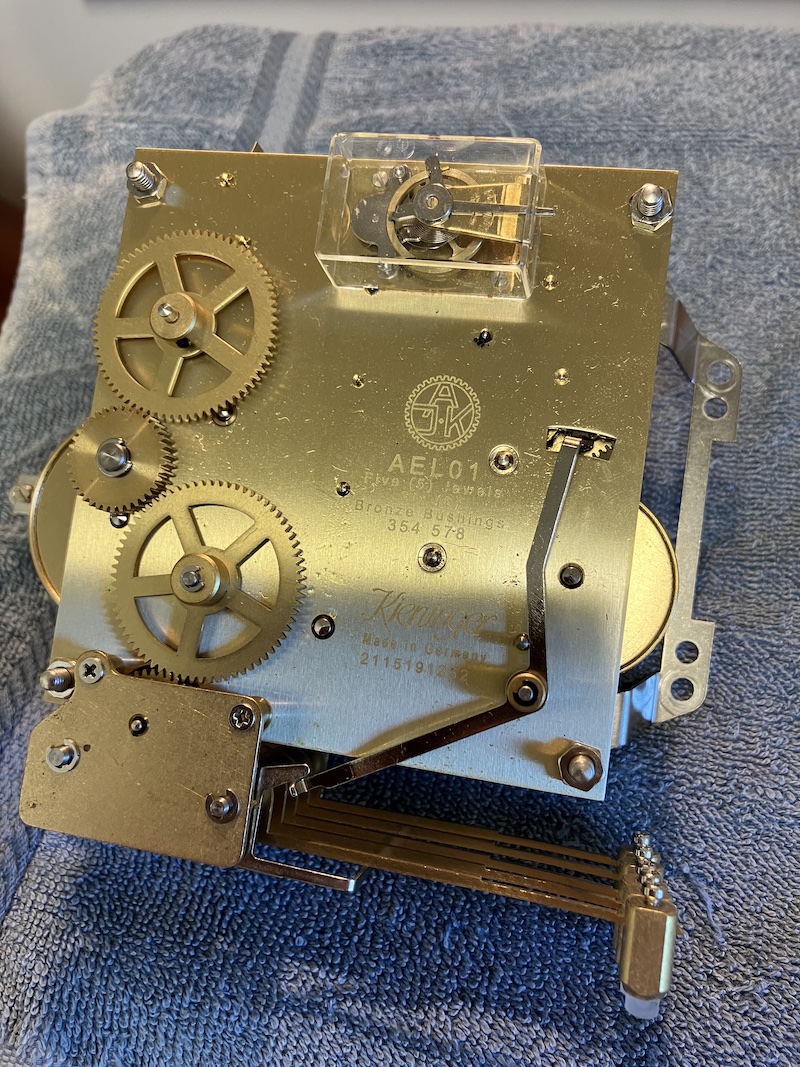
Most people who bring a mechanical clock in for service have no idea what complete disassembly involves. They picture a craftsman oiling the gears, perhaps cleaning the case, and sending the clock home running again. That is a different service, and it produces a different result.
Complete movement disassembly means exactly what it says. Every plate comes apart. Every gear, every pinion, every jewel, every click spring, every screw, every component comes out and goes onto the bench individually. The movement is reduced to its parts and each one is examined under magnification.
Why it matters
A mechanical clock movement accumulates wear in ways that are not visible from outside. Pivot holes wear oval over decades of running. Mainsprings develop set and lose power. Wear on the gear teeth creates inefficiency that compounds through the train. None of this is apparent from watching the clock run, and none of it shows up on a routine oiling visit.
The consequence is a clock that runs for a year or two after surface service, then stops again. The owner brings it back. It gets oiled again. This cycle repeats until the underlying wear becomes too severe to ignore, and by then the job is significantly harder and more expensive than it would have been with a complete service at the outset.
A clock that runs for six months after an oiling visit is not a restored clock. It is a clock on borrowed time.
What the disassembly reveals
When the plates come apart, the condition of every component becomes visible. Worn pivot holes. Springs that have lost tension. Pivot points that are scored from running without adequate oil for years. Hairline cracks in plates that would have gone undetected. These are the findings that drive the real scope of a restoration, and they cannot be identified without taking the movement completely apart.
This is why a starting estimate is an honest estimate and nothing more. I can tell you approximately what a movement of that age and type typically needs. I cannot tell you with certainty what your specific movement needs until it is apart in front of me.
Springs are replaced as standard practice
Mainspring replacement is not an add-on at The Timekeeper Atelier. It is standard practice on every complete service. A mainspring that was installed in 1960 has been running for sixty-plus years. It has cycled through tens of thousands of winds and releases. The spring may still function, but its elasticity has degraded, its power output is inconsistent, and its failure risk is real. Replacing it is not optional when the goal is a clock that runs for decades rather than seasons.
Hand-fabricated parts
Antique clock movements present a regular problem: parts that no longer exist in commercial supply. The manufacturer closed generations ago. The part was never widely reproduced. The only option is to make one.
Fabricating a replacement part at the bench is not a specialty service. It is a standard part of working on antique movements. Every clockmaker who does complete restoration work has this capability, or should. The question is whether the craftsman is willing to do it or whether they send the movement back with a note saying the part is unavailable.
What you take home
A clock that has received a complete movement service should run well for decades. Not years. Decades. The movement has been cleaned, adjusted, worn components replaced, and reassembled to tolerance. It has been set up and regulated before it comes back to you.
That is what the clock deserved when it was made. That is what it deserves now.