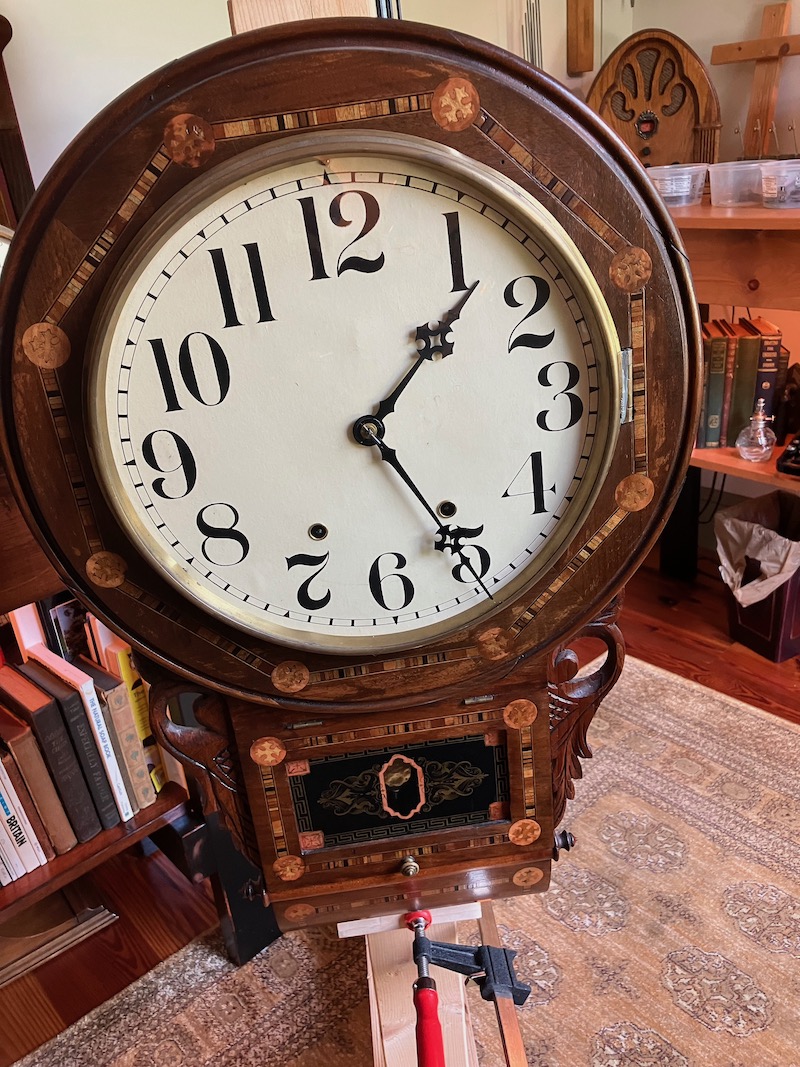
There is a grandfather clock in a lot of Eastern Kentucky homes that has not run in years. The owner knows it needs service. They have known for a while. But finding the right person to work on it has proven harder than the problem itself.
This is not a story about neglect. It is a story about geography. The infrastructure for mechanical clock service, meaning real bench work on real movements, has not existed in this region for a generation. When a clock went silent, the practical options were to drive two or three hours to Lexington or Louisville, ship it across the country at significant risk, or leave it in the corner and figure it out later. Most families chose the corner.
The service gap is real and it is regional
The NAWCC, the National Association of Watch and Clock Collectors, maintains a national repair index. It lists exactly one Kentucky entry for mechanical clock service: a shop in far western Kentucky, near the Ohio River. There is nothing in eastern Kentucky. Nothing in southern West Virginia. Nothing in the tri-state corner where Kentucky, West Virginia, and Virginia meet.
For a clock owner in Pikeville, Prestonsburg, Hazard, Williamson, or Grundy, the nearest comparable mechanical clock restorer is roughly two and a half to three hours away. That is not a trip someone makes with a seven-foot grandfather clock in the back of a truck. Smaller mantel and shelf clocks can make the journey, but many families never get around to it.
The clock goes silent. The family says they will deal with it eventually. Eventually becomes years. Years become a decade.
What clocks are sitting in those homes
The largest category is grandfather clocks sold between the 1970s and the 2000s. Howard Miller, Sligh, Ridgeway, Hermle, and Kieninger were selling heavily during this period, and Eastern Kentucky buyers responded. These are mechanical floor clocks, weight-driven with pendulums, built to run for decades with periodic service. They are now anywhere from twenty-five to fifty years old. Many of them have never had a complete service. Some have never had any service at all.
A clock of that age that has never been serviced is not necessarily broken. It is running on borrowed time. The oils have dried. The mainspring has set. Wear has accumulated in the pivot holes and on the gear teeth. The clock may still be running. It may run for another year or another five years. At some point, it will stop, and stopping a neglected movement often means stopping it hard, with worn components, dry pivots, and degraded lubricants throughout.
Alongside the grandfather clocks are the older pieces. Estate clocks, antique mantel clocks, family heirlooms that came with the house or arrived through inheritance. A Seth Thomas from 1920. A Sessions from the 1940s. A German Black Forest piece with a cuckoo that stopped cuckoo-ing in the 1990s. These are the clocks that carry the most memory, and they are also the ones most likely to have been sitting quiet the longest.
Why shipping is not always an answer
For a small mantel clock with a contained movement, shipping to an out-of-state restorer is a reasonable option. The clock can be packed securely, insured appropriately, and sent with some confidence it will arrive intact.
A grandfather clock is a different matter. These are pieces six to eight feet tall, often weighing over one hundred pounds, with movements that require the pendulum to be removed, the weights to be detached, and the case to be carefully prepared for transit. They are not designed to ship. The owners who have tried to make it work have often found the experience more stressful and more expensive than expected, and some have had pieces arrive damaged.
For those clocks, in-home service is the only practical answer. A craftsman who travels to the piece, services the movement on-site, and leaves the clock running in its own space is not a premium option. It is the standard of care that large mechanical clocks require.
What this means for families
If you have a clock in your home that has not run in a year or more, the movement is not necessarily beyond saving. Mechanical clocks are built to last, and a good many of them come back to life with a complete service even after sitting quiet for a decade. The question is whether the wear has progressed to the point where components need to be replaced or fabricated, and that question can only be answered at the bench.
The first step is a conversation. Describe the clock, its approximate age, and what it was doing when it stopped. A starting estimate is possible from that description. The full scope becomes clear once the movement is apart.
The clock in the corner is not waiting to be thrown away. It is waiting to be looked at by someone who knows what they are looking at.