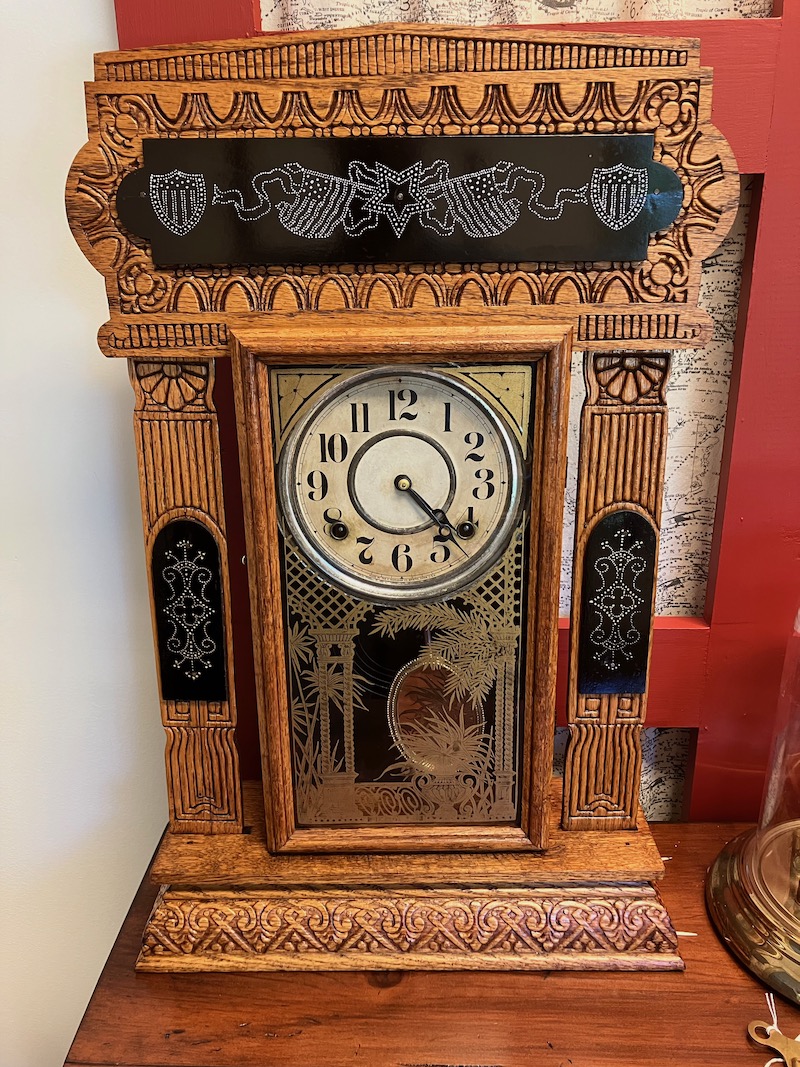
Estate sales and antique shops produce mechanical clocks regularly. Some of them are worth buying. Some of them are not. The difference is not usually obvious from looking at the case, and the estate sale organizer almost certainly cannot tell you. You need to be able to evaluate the piece yourself, or know enough to get the right person on the phone before you commit to a price.
After twenty years of looking at movements that clients bring in after buying something they were not sure about, I have noticed that three questions cover most of what matters. If you can answer them for a given piece, you can make an informed decision about whether the clock is worth buying and what a realistic path to running condition actually looks like.
Question 1: Is the movement mechanical?
This is the first filter, and it eliminates a significant portion of what you will see at estate sales. A mechanical clock is wound by hand, either with a key, by pulling a chain, or by winding a knob. It runs on a mainspring or hanging weights. It has a pendulum or a balance wheel as its regulating element. It ticks audibly and produces the chime through mechanical action.
An electric clock, a quartz clock, a battery-powered clock, and a clock with a motor-driven pendulum are all different things. They do not require the same service and are not in the same category as restoration candidates. The question is simply whether the clock in front of you is mechanically wound and mechanically regulated.
If you are not sure, look at the back of the movement. A mechanical movement is full of gears, springs, and levers, visible through the back plate or through an inspection door. An electric or quartz movement will have a circuit board, a battery compartment, or a plug. If there is any electric component, that piece is outside the scope of mechanical clock restoration.
The case can look like an antique and still have a battery movement inside. Always check the back before you decide anything.
Question 2: Is the movement complete?
A movement that is missing components is a fundamentally different proposition than one that is intact. Missing parts in antique clock movements can range from trivial to irreplaceable, and you cannot always tell from the outside what is absent.
The most important things to look for: Is the pendulum present? For floor clocks and many wall clocks, the pendulum is detachable and is frequently separated from the clock for transport or storage. It may be elsewhere in the house. The absence of the pendulum does not mean it is lost, but it is worth confirming before you buy.
For smaller movements, look through the back and count the obvious components. Two springs for a two-train movement, one spring for a single-train movement. Hands present on the dial. Key or winding arbors intact. If something looks missing, absent, or broken at a casual glance, flag it. A missing component in a nineteenth-century American movement may be fabricatable. A missing component in an obscure German movement from the same era may require months to source or may not be sourceable at all.
Incomplete movements can still be worth buying if the price reflects the complexity of the restoration. They are worth walking away from if the seller has priced them as though they are complete and running.
Question 3: Does the case show signs of serious moisture or structural damage?
The movement is almost always recoverable. The case is where irrecoverable damage lives.
Movement restoration is labor and skill. Case restoration is labor, skill, and in some situations, materials that simply cannot be replicated. Veneer that has delaminated, wood that has swelled and split from sustained moisture exposure, or inlay that has been lost and cannot be matched, these are the conditions that turn a restoration into a reconstruction and drive cost past what the piece is worth.
Look at the corners and the base. These are the areas where moisture accumulates and where structural failure tends to start. Press gently on veneer surfaces to feel for loosening. Look at the finish for bubbling, crazing, or dark staining that follows the grain, which indicates water intrusion. Open the door and examine the interior wood, which is often unfinished and shows moisture effects plainly.
Some case damage is cosmetic and addressable. Wood that has been refinished in the wrong color, hardware that has been replaced incorrectly, or surfaces that have accumulated decades of wax buildup can all be corrected without replacing material. The question is whether the wood itself is sound. If it is, the case can be worked on. If it is not, the conversation about value changes significantly.
When to send a photo before you buy
If you are looking at a clock at an estate sale and you are genuinely uncertain whether it is worth the asking price, the fastest thing you can do is take a photograph of the movement and send it to a clockmaker before you decide. Photograph the movement from the back with the back door open, photograph the dial, and photograph any case damage you have noticed. A craftsman can usually tell you within a few hours whether the piece is interesting, whether the price makes sense for what the restoration will cost, and whether there are any obvious red flags you have not considered.
That conversation is free. It takes five minutes to request and usually produces a clear answer. The alternative is buying something you are not sure about and finding out the answer later, when the decision has already been made.